
 Ancient Egypt Home
Pharaohs
Egyptian Gods
Egyptian Pyramids
Hieroglyphics
Temples
Life in Ancient Egypt
Maps of Ancient Egypt
History of Egypt
The Queens of Egypt
Mummies
Religion
Cities and Regions
Ancient Egypt Facts
Ancient Egypt For Kids
Ancient Egypt Home
Pharaohs
Egyptian Gods
Egyptian Pyramids
Hieroglyphics
Temples
Life in Ancient Egypt
Maps of Ancient Egypt
History of Egypt
The Queens of Egypt
Mummies
Religion
Cities and Regions
Ancient Egypt Facts
Ancient Egypt For Kids
Alexandria
In the northwest part of Egypt, running alongside of the Mediterranean Sea is a city called Alexandria . The city was named after Alexander the Great, who founded it around 334 BC during his epic conquests. There were many Alexandrias founded during Alexander the Great's conquering trips, but none so famous, large, or wealthy.
Location
The city of Alexandria is on the coast of Egypt, at the edge of the Nile Delta. Lake Mariut borders the city on the south. The northern and southern sides of the cities had ports. Some of the harbors could hold 1,200 ships.
When the Greeks built Alexandria, the Canopic Branch of the Nile flowed close to the city. Canals brought fresh water from the the river to the city and Lake Mariut. Alexandria was on the trade routes from the east, west and south. It also served as a port for Roman grain ships trading for wheat and other grains.
The Alexandria of today is very different from the ancient city. The Canopic Branch of the Nile silted up by the 13th century AD. Scientists have learned that Alexandria sits on the fault line between two continents. This means that the land the city sits on has sunk around 20 feet since its establishment.
During the past 2,000 years, the level of the Mediterranean has risen four or five feet. As a result of the rise of the sea level and earthquakes, most of the ancient Alexandrian shoreline is underwater. Archaeologists have mapped the underwater ruins. Construction often brings ruins to light, so archaeologists have to conduct rescue digs.
The History of Alexandria
Scholars believe an Egyptian site named Rhakostis may have been at the site of Alexandria. Scholars differ about whether this was a fishing village or a guard post. To date, archaeologists have found no remains of Rhakostis on land. The Greek founded Alexandria in 331 BC.
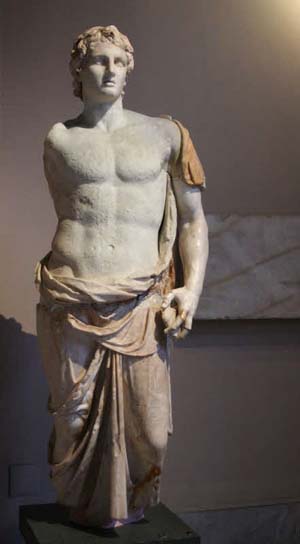
Statue of Alexander the Great
Alexander the Great chose the site for Alexandria and planned the boundaries. Dinocrates of Rhodes organized the city which covered an area of about nine miles. Scholars think that 400,000 people might have lived in Ancient Alexandria, although population estimates might be incorrect because archaeologists have not yet excavated the whole city.
Alexander gave his general, Ptolemy, governorship of Egypt. He set up his government in Alexandria. After Alexander's death in 323 BC, Ptolemy intercepted the king's body and buried him in Memphis, while he built a tomb in Alexandria, that would later become a 'tourist' site for the ancient Egyptians. However, it remains unknown to the modern world.
The Ptolemies ruled Egypt for almost 300 years. The last Ptolemaic ruler was Cleopatra VII. She committed suicide before Octavian Augustus could imprison or execute her. After this, the Roman empire ruled Alexandria.
When the Roman empire split, Egypt was a part of the Byzantine Empire. The Arabs conquered Alexandria in the late seventh century. Scholars have found it difficult to learn about the city during each phase of its existence, because of the modern city. Archaeologists are continuing to excavate and will shed more light on ancient Alexandria's history.
The Culture of Ancient Alexandria
Evidence suggests that the culture of ancient Alexandria was a mix of Egyptian and Greek ideas. The Ptolemies brought sculptures and architectural pieces from Heliopolis to decorate their city. They blended some Greek gods with Egyptian deities and also instituted a new god, Serapis. His attributes came from several Greek and Egyptian gods.
Alexandrians decorated their tombs with Greek and Roman scenes. Scholars have found tombs with paintings that blended the two artistic styles. The Greeks cremated their dead, while Alexandrian graves contained both bodies and crematory urns. The Greek government did not recognize marriages between Greeks and Egyptians, yet mixed relationships did take place.
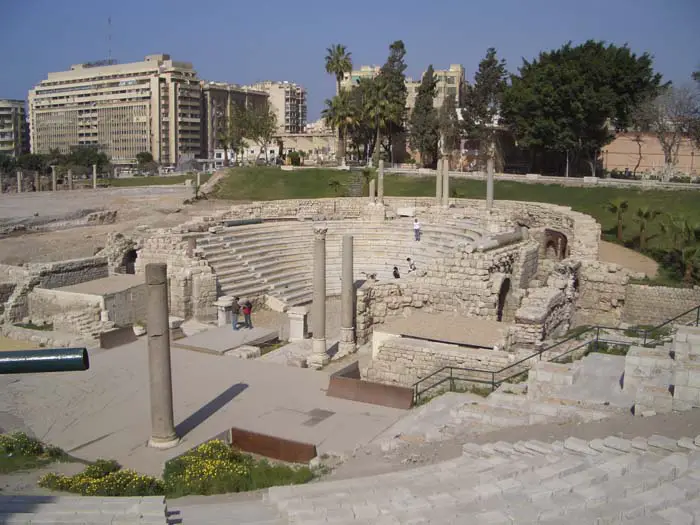
© Loise - The Ancient Roman Theatre in Alexandria
Ancient Alexandria's Layout
The Hellenistic walls that surrounded the ancient city stood once almost 30 feet high, now reduced to a fragment of the original construction.
The city was initially organized in a Hellenistic grid. There were two large streets, about 46 feet wide, one running North/South and the other running East/West. Other roads, around 23 feet wide, divided each section or district into blocks. Smaller streets divided each block. The street layout allowed the northern winds to cool the city.
Greek, Egyptian and Jewish citizens each lived in a different quarter. The royal quarter was in the northern section of the city. It is now under the water of the East Harbor. The necropolis of the city was outside the ancient walls.
Citizens built villas along the shores of Lake Mariut for growing grapes and making wine. The harbors were either built or expanded. Builders added breakwaters to the seaboard harbors. A causeway connected the Island of Pharos to Alexandria. The famous Lighthouse of Alexandria was built on one side of the island to guide ships into the port.
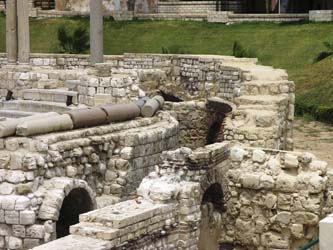
© Daniel Mayer - Ruins of the Amphitheater
The Lighthouse of Alexandria
The Lighthouse of Alexandria was one of the Seven Wonders of the Ancient World. It was the only Wonder with a practical, secular use. Today, the building's remains lay underwater, near Fort Qait Bey. Scholars have a good idea of its dimensions and shape from ancient records, images and models.
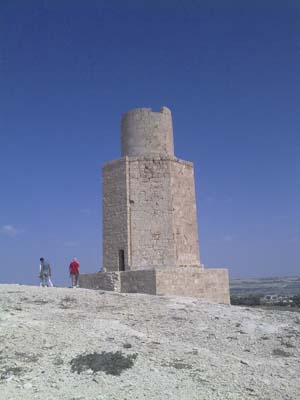
© Aymantarek24 - Scale Replica of the Lighthouse
Scholars estimate the lighthouse was between 400 and 500 feet tall. Images and records say the Ptolemies built the lighthouse in three tiers. The bottom level of the lighthouse was a square, the middle tier was octagonal and the top level was cylindrical. Builders designed a ramp approach and a spiral staircase inside.
Little information detailing the beacon and the inside of the top two tiers exist. It is believed the top tier had collapsed by 796 BC. Devastating earthquakes destroyed the remains of the lighthouse at the end of the 14th Century.
Existing evidence suggests the beacon held a large open fire, and a mirror reflected the light to guide ships. What scholars find unclear is the shape of the lighthouse's top. Ancient records talk about a statue or a pair of statues that were on top of the lighthouse. Scholars think an extended fire might have weakened any top of the building and caused it to collapse.
Excavations of the underwater ruins have revealed that the Ptolemies brought statues and obelisks from Heliopolis. They placed these objects around the lighthouse to show they controlled Egypt. Scholars found 40 feet tall colossal statues of a Ptolemaic couple dressed as Egyptian gods.
The Lighthouse of Alexandria stood for 17 centuries.
The Library of Alexandria
The Library of Alexandria was in the royal quarter and sheltered around 700,000 scrolls. The Ptolemies acquired or stole other libraries and scrolls from visiting ships. They meant for the library to become a center of knowledge in the Hellenistic world.
The Ptolemies gathered records from all over the known world. Many scholars worked in the library, and they made discoveries in a variety of subjects. Eratosthenes calculated the earth's circumference. Euclid formulated geometry, and Archimedes designed mechanical devices.
At some point in history, the Library burned from unknown reasons, whether the fire was intentional or accidental. The Serapion, a temple to Serapis, served as an annex to the Library. It held 200,000 scrolls until it burned at the end of the fourth century. By 640 AD, all the scrolls from the Library of Alexandria were gone.
Ancient Alexandria Museum
The Museion was the museum of Ancient Alexandria. It was associated with the Library, and it was in the royal quarter. A museion was a temple for the Muses. These nine goddesses inspired artists, scholars and scientists.
A variety of scholars worked in the Museion, studying, among many other topics, medicine, philosophy and astronomy. Students were taught in the Museion and the Library. The Museion's fate is unknown, but its ruins might lay underwater today.
Other Buildings
Caesareum
Cleopatra built the Caesareum to honor Marc Antony. Augustus dedicated it to the worship of the Roman Emperors. The two obelisks modern visitors dubbed “Cleopatra's Needles”, stood outside the Caesareum. Thutmose III was, in fact, the one who commissioned these monuments which are now in England and the United States. Greeks or Romans had initially brought them to Alexandria from Heliopolis.
Cisterns
A series of connected cisterns are under Alexandria. They provided water for the ancient population. They have three levels of columns with arches connecting them. Until the late 20th Century, scholars only knew the location of one cistern. Today, archaeologists have found over 100 cisterns, and are trying to open some to the public.
Cemeteries
Catacombs of Kom el-Shaqafa
A 65 foot deep shaft leads to the Catacombs of Kom el-Shaqafa. A burial chapel combines Greek and Egyptian symbology. People hollowed out other chambers to form catacombs with places for bodies and urns. Scholars also found a room for funerary banquets.
The Necropolis (Gabbari)
A rescue dig in this area revealed over 17 tombs. Hundreds of niches in the walls held one or multiple bodies each. Burial urns were on the tomb floors. Scholars determined these were middle-class tombs.
Alexandria Facts
- Alexander the Great established Alexandria in 331 BC.
- One of the Seven Wonders of the Ancient World, the Pharos Lighthouse, was in Alexandria.
- The Library and Museion of Alexandria were an ancient center of knowledge.
- The Ptolemies ruled Egypt from Alexandria for 300 years.
- Alexander the Great's tomb was in Alexandria, but archaeologists have not found it, to date.
- Today, the remains of the Pharos Lighthouse and the royal quarter are underwater.
- Archaeologists are uncovering more information about ancient Alexandria every year.

