
 Ancient Egypt Home
Pharaohs
Egyptian Gods
Egyptian Pyramids
Hieroglyphics
Temples
Life in Ancient Egypt
Maps of Ancient Egypt
History of Egypt
The Queens of Egypt
Mummies
Religion
Cities and Regions
Ancient Egypt Facts
Ancient Egypt For Kids
Ancient Egypt Home
Pharaohs
Egyptian Gods
Egyptian Pyramids
Hieroglyphics
Temples
Life in Ancient Egypt
Maps of Ancient Egypt
History of Egypt
The Queens of Egypt
Mummies
Religion
Cities and Regions
Ancient Egypt Facts
Ancient Egypt For Kids
Ancient Egyptian Mummies
The ancient Egypt mummies have fascinated the modern world since Howard Carter uncovered the tomb of King Tut. People have discovered thousands of mummies in Egypt. Individuals destroyed many and used them for fertilizer or medicine. Some scholars threw them away because they did not consider them important as artifacts. Today, scholars realize how useful studying mummies is in learning about ancient Egypt.
History of Egyptian Mummies
The Egyptians believed that part of a person’s soul, the ba, returned to the body every night after death. Preserving the body was, therefore, crucial to the soul's survival in the afterlife.
The oldest Egyptian mummies scholars have found are examples of natural mummification. The Egyptians buried the dead in sand and they dried out naturally. Later, seeing how well preserved the bodies were, people sought to perfect an artificial mummification process.
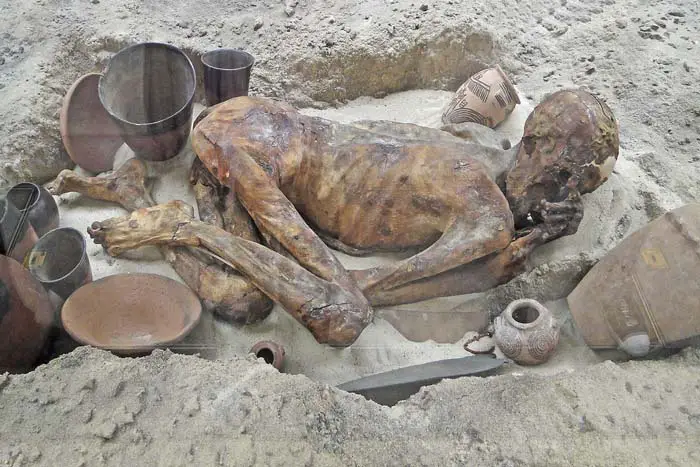
© fmpgoh - Grave from the early badarian period
Beginning in the Old Kingdom Period, scholars have found evidence of artificial mummification. Embalmers wrapped mummies in linen, with each limb wrapped separately, not always dehydrated. They placed more emphasis on making the person appear life-like than preserving the body.
Beginning in the Fourth Dynasty, the embalmers began removing and preserving organs, placing them in four Canopic jars, made of limestone or alabaster. Scholars discovered remains of organs in alabaster chests divided into four sections. However, not many early mummies are intact enough to study.
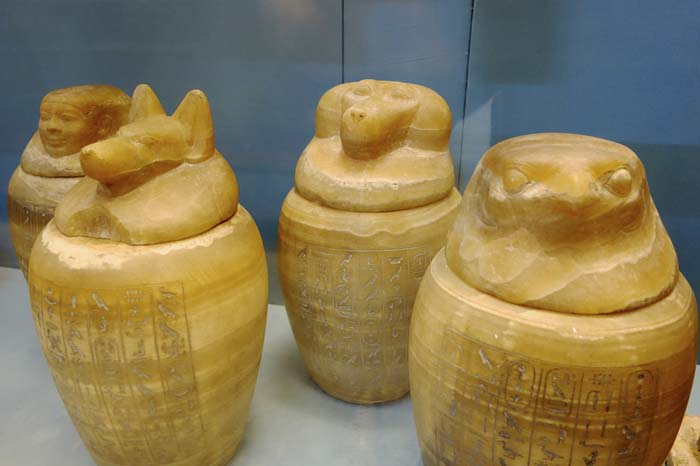
© Christina B Castro - Canopic Jars
Some royal mummies from the Middle Kingdom exist. These 11th Dynasty queens had their organs inside. Their jewelry left imprints on their skin, which is evidence that their bodies were not dried when the embalmers wrapped them.
The New Kingdom Period was the high point of Egyptian embalming. Embalmers buried royals with their arms crossed over their chests. During the 21st Dynasty, tomb raiders began invading royal tombs. They unwrapped the mummies looking for amulets made of precious metals. Priests collected the royal mummies, re-wrapped them and buried them in caches.
The tomb raids led to changes in burial practices. Since the raiders destroyed many of the Canopic jars containing the bodies' organs, embalmers began preserving the organs, wrapping them and replacing them in the body.
Late Period mummies show a deterioration of embalming techniques. Scholars found mummies with missing body parts. Other mummies had disarticulated bones wrapped in the shape of a mummy. X-rays of one mummy, Lady Teshat, show that she has an extra adult skull between her legs.
Greco-Roman mummies show a continued deterioration of embalming methods, but interesting improvements in the wrapping techniques. Craftsmen weaved uniform bandages which allowed embalmers to wrap bodies in elaborate patterns. The most popular was a diagonal pattern that created a series of small squares.
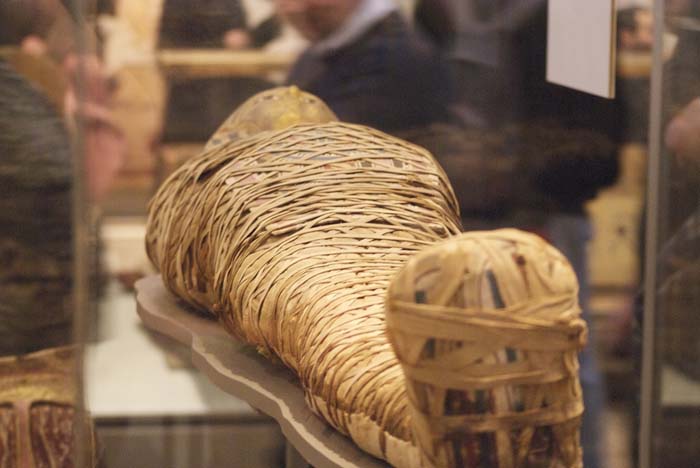
© Paul Hudson - Diagonal wrapping pattern on a mummy
Portrait masks were a unique feature of these mummies. During a person’s life, an artist painted an image of him/her on wood. People framed these objects, then displayed them in their homes. Scholars think these are the oldest examples of portraiture. Embalmers appear to have mixed up some of the portraits. X-rays showed one mummy was female, but the portrait was a man.
Egyptians mummified a variety of animals. There were four different reasons for this:
- People mummified their pets because they loved them.
- Other animals, like ducks, were meant to provide food for the dead.
- Egyptians sacrificed, mummified and offered animals, like cats and baboons, to the gods.
- Priests mummified sacred animals, like the Apis bulls, after they died.
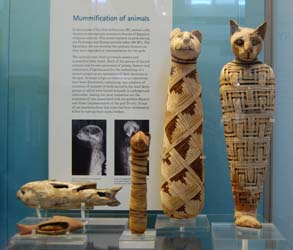
©srgpicker - Cat mummy displayed in a museum
Mummification process
Egyptologists have found price lists of different embalming services. More elaborate burials were available to rich citizens, while pharaohs had the most intricate burials and the best preserved bodies.
Mummification began four days after a person’s death. Families took the body to the Nile’s West bank, where the embalmers worked outdoors. First, the embalmers cleaned the body. Then, they made a slit on the left side of the body and removed the stomach, intestines, lungs and liver.
During most periods, embalmers placed each organ in a Canopic jar, with a natron solution. Natron is a natural composite of salt and baking soda that dried the organs. The four sons of Horus, Hapy, Duamutef, Qebhsenuef and Imsety, guarded the organs. Most Canopic jars had lids shaped like the heads of those four gods.
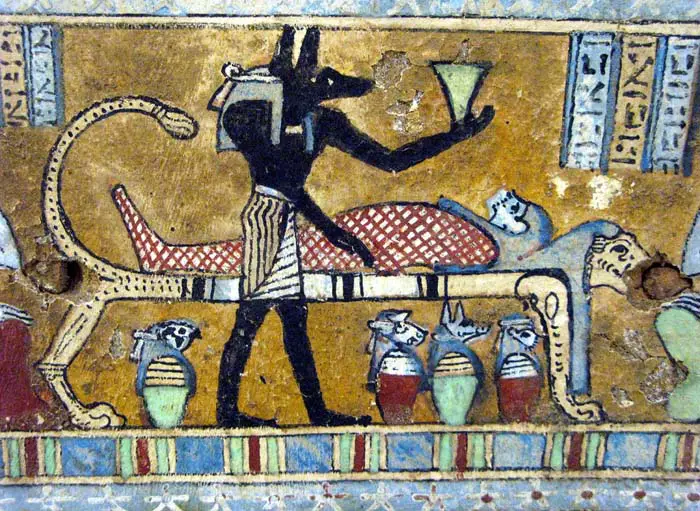
© André - Anubis depicted during the mummification process
The Egyptians placed no value on the brain, as they believed it was unimportant for the body’s function. The embalmers removed it through the nose with a hooked rod. The heart, however, was considered the center of knowledge, and they left it in the body. Sometimes, embalmers put packets of natron in the body cavity.
The body was then placed in a tray and covered with dry natron. 40 days later, it was removed from the natron and the embalmers spent 30 more days wrapping the body and readying it for burial. The Egyptians buried the left over embalming tools in front of the tomb.
During the 21st Dynasty, embalmers tried to make the body look less emaciated, by stuffing linen or other items inside the cheeks to make the face fuller. They also injected a mixture of fat and soda under the skin. At times, however, they injected too much, and the body's skin split.
Egyptian Mummies in Museums
Today, scholars work hard to preserve human and animal mummies in specially designed cases. The most famous mummies are the bodies of the pharaohs, many of these now held in the Cairo Museum. Other mummies are displayed in museums across the world.
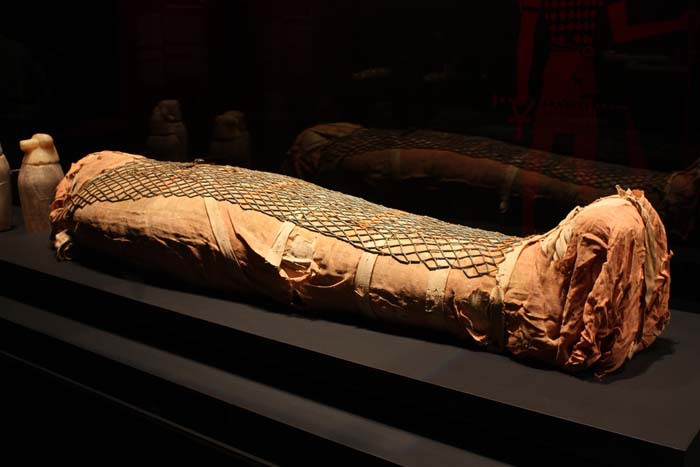
© Alvin Wong - Egyptian mummy exhibit in the National Museum of Singapore
Other mummies were discovered in caches. During the 21st Dynasty, priests gathered the bodies of many pharaohs and put them in a single tomb to protect them. The Deir el-Bahri cache is the most famous of these mass burial sites. Here, Egyptologists found 40 royal mummies, including Ramses II. Scholars found it because peasants were selling relics from the cache. Egyptian authorities tracked it down and removed the mummies and all the artifacts with them. Excavators made no record of the mummies’ locations in the caves during their excavation.
Another cache of royal mummies was kept in the tomb of Amenhotep II. From the total of 14 royal mummies, five remain in the tomb, including the body of the pharaoh. The other nine were in coffins and sealed behind a wall. These included the bodies of other pharaohs, and scholars moved them to a museum.
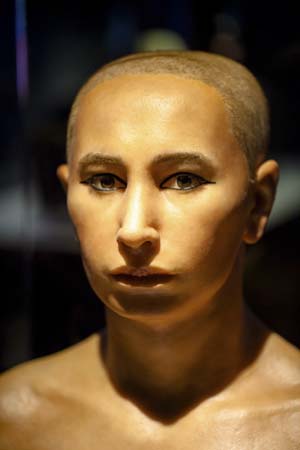
© opacity - Facial reconstruction of King Tut
Scholars have reconstructed the faces of Egyptian mummies and produced images of the pharaohs by measuring and studying their skulls. DNA analysis has been used to help identify mummies and determine if a disease killed them, yielding some interesting information, often disproving myths and theories.
In the case of King Tutankhamun and his family, it was believed that the pharaoh was murdered. The DNA tests revealed that he likely died of malaria and an infection in a broken bone. It also helped identify Tutankhamun’s mother, but her name is unknown.
Two coffins containing fetuses were found in King Tutankhamun’s tomb. These two girls were the king’s daughters. One had several disorders that would have made her deformed. Another mummy from KV 55 was likely King Tutankhamun’s brother.
Egyptian Mummies Facts
- The first Egyptian mummies formed naturally after burial in the desert.
- Embalmers worked for centuries to perfect their art.
- The New Kingdom Period represents the high point of Egyptian embalming.
- Greco-Roman mummies have the most decorative bandages.
- Royal mummies are the finest example of the embalmers art.
- The Egyptians believed part of the soul needed the body to survive in the afterlife.
- Scholars found thousands of animal mummies.
- In later periods, embalmers were not careful with the mummies and broke bones or lost pieces.
