
 Ancient Egypt Home
Pharaohs
Egyptian Gods
Egyptian Pyramids
Hieroglyphics
Temples
Life in Ancient Egypt
Maps of Ancient Egypt
History of Egypt
The Queens of Egypt
Mummies
Religion
Cities and Regions
Ancient Egypt Facts
Ancient Egypt For Kids
Ancient Egypt Home
Pharaohs
Egyptian Gods
Egyptian Pyramids
Hieroglyphics
Temples
Life in Ancient Egypt
Maps of Ancient Egypt
History of Egypt
The Queens of Egypt
Mummies
Religion
Cities and Regions
Ancient Egypt Facts
Ancient Egypt For KidsAncient Egyptian Hieroglyphics
The term hieroglyphics refers to a system of writing using ancient Egyptian symbols. The hieroglyphics involved a series of 'picture' words. Consisting of several hundred words, this system of writing was intensely complex and very labor intensive. The first hieroglyphics were used on buildings and tombs. It is believed that the Egyptians first began developing this system of writing about 3000 BC.
The word hieroglyph means “god's words”. The ancient Egyptians believed hieroglyphs were sacred. For this reason, they carved hieroglyphs on sacred structures, like temples. Hieroglyphs were also used to write sacred books, like the Book of the Dead.
The word hieroglyph is Greek for "Sacred writing" or "God's words"
What are Hieroglyphs?
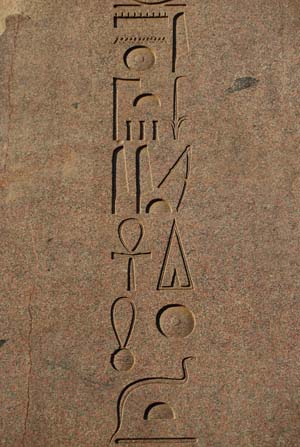
©Aleksandar Cocek - Hieroglyphs at Karnak
Scholars have discovered that there are three different classes of Egyptian hieroglyphics. Some signs belong to more than one class.
- Phonograms are signs that represent a specific sound. Some correspond with the sounds of two or more letters.
- Ideograms represent ideas instead of sounds. Examples of ideograms are the hieroglyphs that represent the gods.
- Determinatives are hieroglyphs that were not spoken or translated. They help make the meaning of words clearer and mark the end of words. The Egyptians placed no spaces between words or sentences.
The Egyptian language did not have written vowels, so the exact pronunciation of ancient Egypt is not known. Due to this, some words used the same constants. Scribes put determinatives on the ends of these words to show which word was meant. These signs also distinguished male names from female ones by placing a sign of a man or woman at the end of the name discussed.
Hieroglyphs are read vertically, horizontally, from right-to-left or from left-to-right. The signs reveal which direction carvings should be read. If the signs face right, they should be read right-to-left. If they face left, they should be read left-to-right.
Click here to learn more about The Hieroglyphic Alphabet
Some objects had inscriptions that were read in two or more directions. The Egyptians believed in creating balanced objects. If an inscription was on one side of a window, then they would carve another inscription on the other side. Egyptians avoided leaving empty space. They stacked their signs and left no spaces between words or sentences.
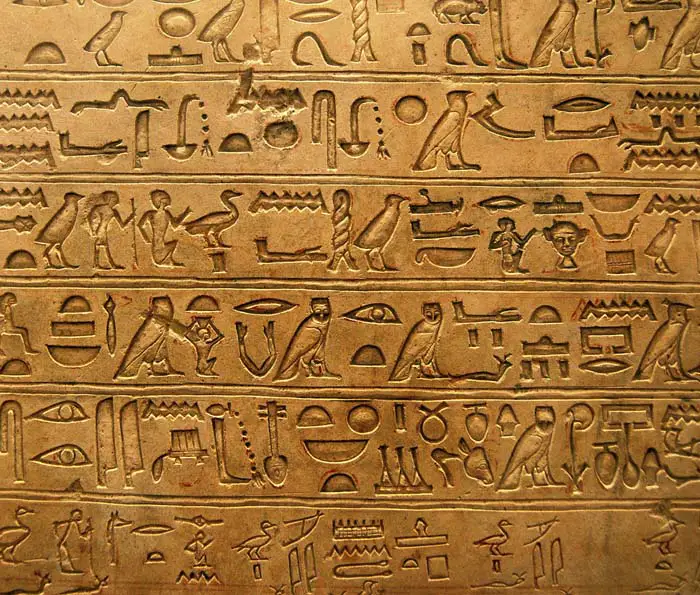
©Andrea - Hieroglyphs
History of Egyptian Hieroglyphs
Scholars believe that Egyptian hieroglyphs developed around 3200 BC. At first, the Egyptians used between 700 and 800 signs. By 300 B.C. Over 6,000 signs were in the written language. Many hieroglyphs came from nature or daily life.
Animals like lions or owls represented sounds or ideas. Shapes represented loops of ropes or houses. While many animals or shapes represented the idea they resemble, not all of them did. People needed specialized training to read and understand hieroglyphs.
Only elite Egyptians, like royals, nobles, priests and scribes, could read hieroglyphs. These people made up about 3% of the population. Scribes went to special schools and some began training at age 12. Students had to begin by learning 200 different signs.
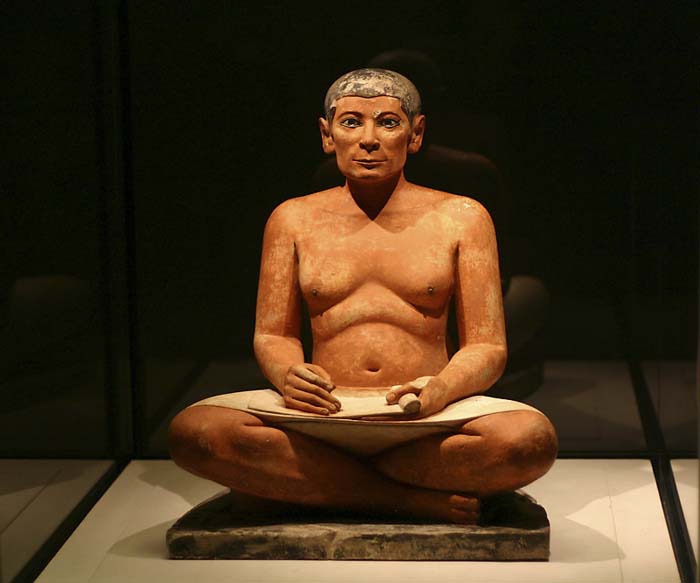
©Ivo Jansch - Statue of a Seated Scribe, displayed at the Louvre
People with a basic knowledge of hieroglyphs knew around 750 signs. A skilled scribe had to memorize over 3,000 hieroglyphs. Scribes earned a good living through their work, and were valued members of the community. They used special tools in their work.
Scribes painted inscriptions on buildings or objects before carvers engraved them. Scribes also used papyrus, a paper-like substance made from plants, as a writing surface. They wrote with reed brushes and different colors of ink. Scribes used red or black ink for words and colored ink for pictures.
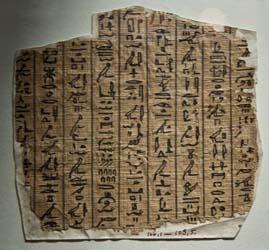
© Quikwhitefox86 - Papyrus Exhibit
Over time, two other Egyptian scripts, hieratic and demotic, developed.
- Hieratic was a cursive form of hieroglyphics with less complicated and connected signs. Scribes used it to write documents and letters, because writing in hieratic was faster. Scribes always wrote hieratic right-to-left and used carved reed brushes.
- Demotic developed around 660 B.C. It was an abbreviated script with signs that did not look like the corresponding hieroglyphs. Writing with demotic was even faster than writing with hieratic.
After the Greeks conquered Egypt, knowledge of hieroglyphics began fading. The royal family and most of the elites spoke Greek. Use of hieroglyphs faded even more after Rome conquered Egypt. Another written form of Egyptian, Coptic, developed.
Coptic used only 30 signs, many of them Greek. Most Coptic signs only represent one sound. Some Coptic words helped scholars decipher hieroglyphics. Modern study of hieroglyphs flourished after the discovery of the Rosetta Stone.
The Rosetta Stone
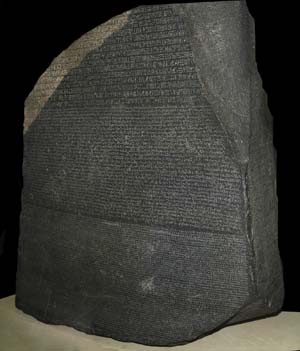
© bathyporeia - The Rosetta Stone
Before the discovery of the Rosetta Stone, scholars had different ideas about hieroglyphs. Many believed that each hieroglyph represented an idea, specifically what the sign resembled. Other scholars thought hieroglyphics followed no rules and would never be deciphered. This changed after the discovery of the Rosetta Stone.
When Napoleon invaded Egypt in the 1790s, he took scholars with him. In 1799, near the town of Rosetta, troops found the Rosetta Stone. The scholars realized it had the same message carved in Greek, demotic and hieroglyphs. The English attacked the French and confiscated it.
The Greek inscription on the stone was translated in 1802. Ptolemy V had commissioned the stone to commemorate the building of a shrine where people worshiped the pharaoh and his ancestors. Details about how often priests were to make sacrifices were in the inscription.
Thomas Young began studying the demotic text in 1814. He identified Ptolemy's name in a cartouche and was the first scholar to realize some hieroglyphs were phonetic, and that the script followed rules.
Young's work set the stage for the work of Jean-Francois Champollion. He began by translating the names of Ptolemy and Cleopatra. Champollion identified signs that represented sounds in each name. He deduced what other signs meant based on the Greek spelling of each name. The first Egyptian names he translated were Ramesses and Thutmose.
Champollion was the first scholar to identify determinatives. He used Coptic to decipher the meaning of some signs. His work opened the door to understanding ancient Egypt and his dictionary served as a foundation for the work of other scholars.
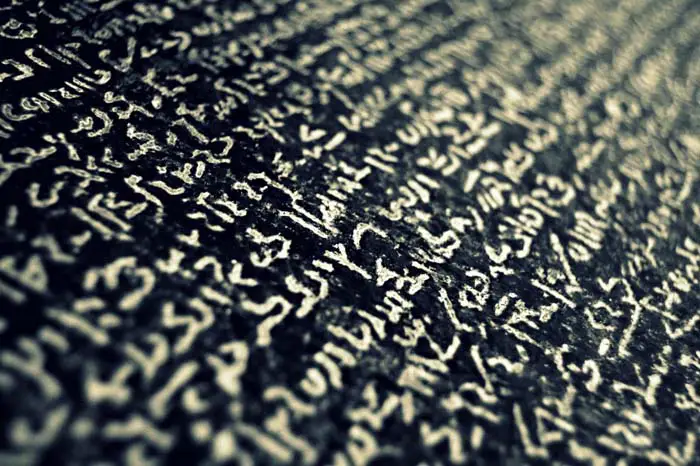
©Eisabeth.Skene - Writing on the Rosetta Stone
Facts about Hieroglyphs
- Hieroglyphs originated in Egypt around 3200 B.C.
- The Egyptians used hieroglyphs until the Roman period.
- Only 3% of the population could read the hieroglyphs.
- Hieroglyphs represent sounds and ideas.
- Determinitive signs reveal the classification, like male or female, of a word.
- Jean-Francois Champollion was the first modern man to read hieroglyphs.
- The Rosetta Stone had the same message in Greek, demotic and hieroglyphs.
- This allowed for the translation of demotic and hieroglyphs.
