
 Ancient Egypt Home
Pharaohs
Egyptian Gods
Egyptian Pyramids
Hieroglyphics
Temples
Life in Ancient Egypt
Maps of Ancient Egypt
History of Egypt
The Queens of Egypt
Mummies
Religion
Cities and Regions
Ancient Egypt Facts
Ancient Egypt For Kids
Ancient Egypt Home
Pharaohs
Egyptian Gods
Egyptian Pyramids
Hieroglyphics
Temples
Life in Ancient Egypt
Maps of Ancient Egypt
History of Egypt
The Queens of Egypt
Mummies
Religion
Cities and Regions
Ancient Egypt Facts
Ancient Egypt For Kids
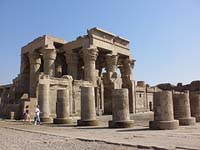
The Temples of Ancient Egypt
Religion was a vital part of Egyptian Society and temples formed an important part of daily life. The people did not gather to worship in the temple. They brought offerings to the gods and participated in various festivals. Many private homes also had a small shrine where the home owners could make offerings to specific gods.
Temples possessed tremendous social and political power. They employed a variety of people, from priests to craftsmen. Temples also owned farmland, which provided them with food and goods. They received booty from every military campaign, including prisoners. Pharaohs often gifted a temple with more land or with other goods.
The classification of temples in Egypt usually refers to two main types:
- Cultus (religious): temples dedicated to a main deity, most having other gods as well. These temples provided a 'residence' or shelter for the gods. Here, priests used to perform rituals and ceremonies, give offerings, pray and tend to the needs of the gods. Some festivals also took place in cultus temples, which allowed all other Egyptians to participate to rituals of worship.
- Mortuary: for a pharaoh’s funerary cult. The funerary cult offered food and clothing to the departed pharaoh to ensure s/he would continue helping the people of Egypt. Mortuary temples were only built for the pharaoh. At first, these temples were part of the tomb complex. Most pyramids had a mortuary temple beside them for the pharaoh buried in the temple. Later pharaohs wanted to hide their tombs so they built their temples away from their tombs.
Famous Temples: The Theban Necropolis
The Theban Necropolis temples were on the west bank of the Nile near the Valley of the Kings. Some of the most famous temples built there were Deir-El-Bahri, Medinet Habu, and the Ramesseum. Deir-El-Bahri has several buildings including the mortuary temples of Thutmose III and Hatshepsut. The temple of Thutmose III suffered extensive damage due to a landslide in antiquity. Later people took stones from the temple to build later structures.
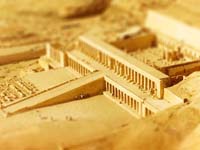
Hatshepsut's Mortuary Temple
Hatshepsut’s mortuary temple is well preserved and Egyptologists reconstructed it during the 20th century. Some scholars believe the scientists made errors during its reconstruction. It is the centerpiece of Deir-El-Bahri and the builders carved it into the cliff face. The temple consists of several terraces with ramps leading up to the top of the different terraces. The building is 97 feet tall and most of its statues were destroyed by rulers who wanted to erase Hatshepsut’s rule.
Click here to discover more about The Temple of Hatshepsut
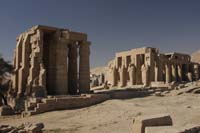
The Ramesseum
The Ramesseum is the temple built by Ramesses II and it took over twenty years to complete. At least, two pylons are part of this temple and it also has a Hypostyle hall. The builders placed several monumental statues of the pharaoh in this temple. The inscriptions record some of the pharaoh’s military actions. A temple dedicated to his first wife and his mother is next to the temple. The flooding of the Nile has damaged this temple and it is not as well preserved as other examples.
Click here to discover more about The Ramesseum
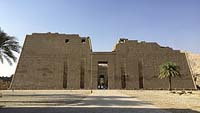
Medinet Habu
Medinet Habu is the temple of Ramesses III. Reliefs in this temple depict the arrival and defeat of the Sea Peoples. It is 690 X 1000ft and there are over 75,000 sq. ft. of wall reliefs. A mud brick wall surrounds this temple and has aided its preservation.
Click here to discover more about Medinet Habu
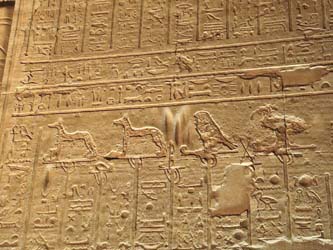
© isawnyu - Wall reliefs at Kom Ombo temple
Other Famous Temples and Temple Complexes
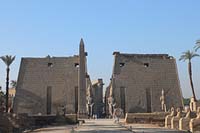
Luxor Temple
This temple is on the east bank of the Triad. The Theban Triad (Amun, Mut and Khonsu) was worshiped here. During the Opet Festival, the statue of Amun at Karnak traveled to the Luxor Temple. This was a festival to promote fertility.
Click here to discover more about The Luxor Temple
Karnak
Karnak is the site of the largest temple complex in Egypt and the second largest ancient complex after Angkor Wat in Cambodia. It was the center of the worship of Amun and had four separate temple complexes (one of which was dismantled). The three extant precincts contain temples for Amun, Mut and Montu. Priests built chapels for other deities in each precinct and each contained its own sacred pool. Karnak’s construction is diverse because at least thirty different pharaohs built the precincts.
Click here to discover more about Karnak
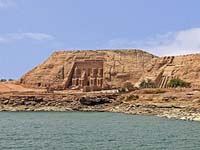
Abu Simbel
Abu Simbel is the name given to two temples built by Ramesses II. Priests dedicated these temples to the pharaoh and Queen Nefertari. Ramesses II’s temple was also dedicated to three of the national gods of Egypt and Hathor was the goddess worshiped in Nefertari's temple. The builders carved the temples out of a mountain and Egyptologists moved them in the 1960s when they were in danger of flooding. The temples’ construction demonstrated the pharaoh’s power to his southern neighbors.
Click here to discover more about Abu Simbel
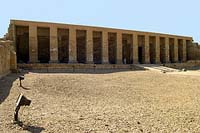
Abydos
Abydos was the site of the mortuary temple of Seti I. This temple is important to Egyptologists because a relief included the Abydos King’s list. Some of Abydos’ ancient temples are under the modern town on the site. Abydos was one of the centers of Osiris’ worship and it was a place that claimed to be Osiris’ tomb.
Click here to discover more about The Temples of Abydos
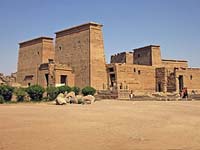
Philae
Philae was an island with several temples that was also moved in the 1960s to protect them from flooding. Temples to Hathor and Isis were on the island. The island of Philae was a sacred space and only priests could live there. Another tomb of Osiris was on the island.
Click here to discover more about The Temples of Philae
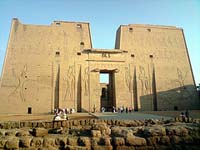
Edfu
Edfu is the sight of a well-preserved temple dedicated to Horus. Its construction took place in Ptolemaic times over a New Kingdom temple. Egyptologists have found several small pyramids near Edfu. Their builders are unknown but scholars are studying them.
Click here to discover more about The Edfu Temple
Kom Ombo
Kom Ombo is a unique double temple. Two sets of courts, halls, sanctuaries and rooms are on each side of a main axis. The gods worshiped in the northern section were Haroeris, Tasenetnofret and Panebtawy. The gods of the southern section were Sobek, Hathor and Khonsu. Egyptologists have restored this temple. Egyptologists found several hundred crocodile mummies (Sobek’s animal symbol) near the temple site.
Click here to discover more about Kom Ombo
Dendera
The temple complex at Dendera covers 40,000 square meters. Composed of several buildings from different periods, it is one of the best preserved sites of ancient Egypt. The main structure is the temple dedicated to Hathor, the goddess of love and motherhood. Notable findings in the complex are the Dendera Zodiac, the necropolis, the Dendera Light and the colorful paintings on the ceiling of the temple.
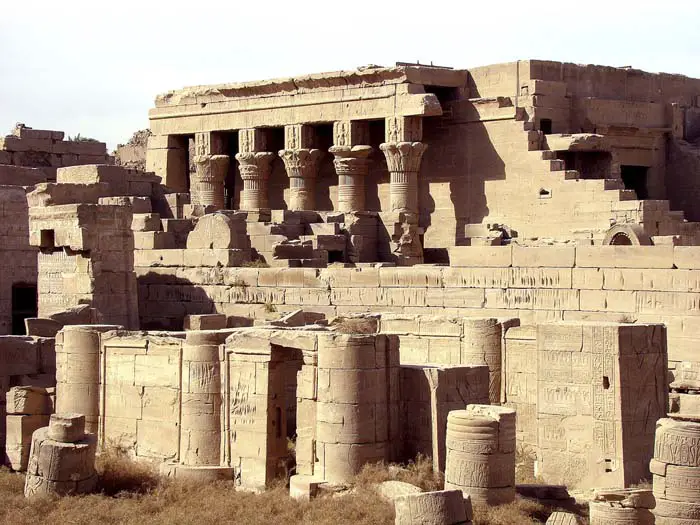
© Richard White - Dendera Temple
Sacred Space
The sacred space is an area set aside for the worship of a deity. People constructed a temple or shrine to the god on the space to worship the deity. They chose a sacred space because of its location or because a deity sent a sign that the area was special. After the priests chose a space, they conducted rituals to purify the space and built a religious structure.
Priests used these spaces for centuries and constructed new buildings over older buildings. Excavating religious sites can be difficult because a temple structure is often on the surface. Digging down to see the lower level is challenging due to the extant building. The excavation has the potential to damage the temple on the surface.
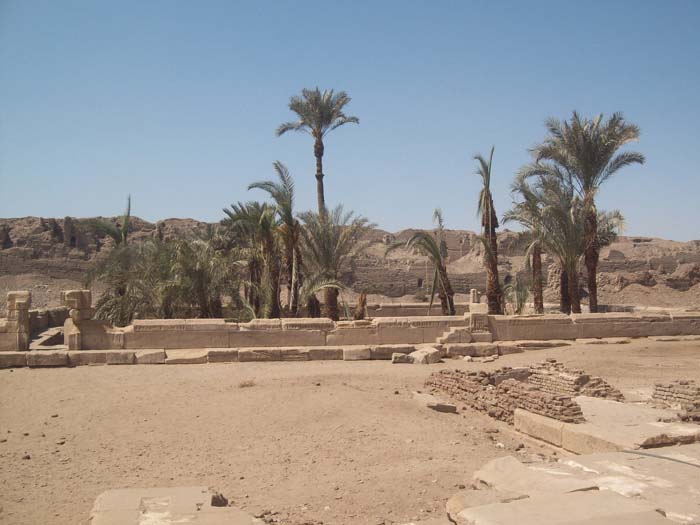
© isawnyu - The Sacred Lake at Dendera Temple
Public Temples
Through the years, temples served a variety of purposes. The primary purpose of most temples in ancient Egypt was to house and care for the gods to which they were dedicated. It seemed the very existence and good fortune of the entire land of Egypt rested upon tending to the gods. The worst fate that could befall a city was failing to care for the temple of the patron god. A god who lacked attention would become angry and flee the temple, leaving the citizens of that town open to all kinds of disasters.
Beyond serving the needs of the gods, some temples also served other purposes. No king could rule the Egyptian nation without first becoming a god. In an elaborate ceremony, the new pharaoh would enter the temple, along with the high priests. Once inside the most exclusive chambers of the temple, they would perform rituals meant to transform the mere mortal pharaoh into a deity. The king would then be revered and worshiped by the Egyptian people, some temples having been reserved for the worship of the pharaoh.
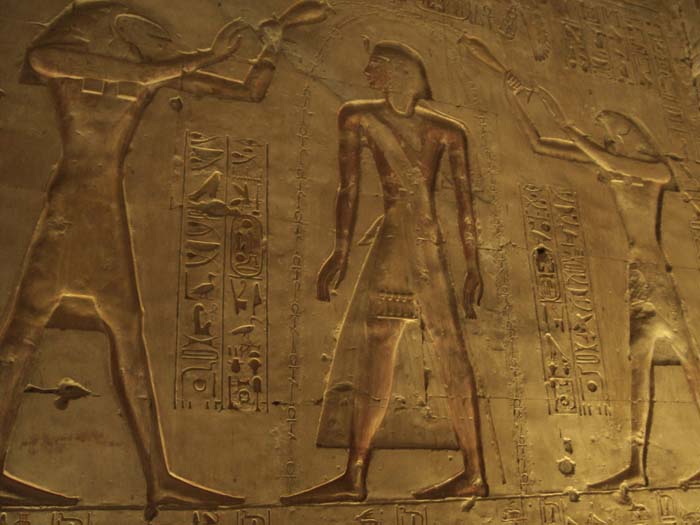
© isawnyu - Relief depicting two gods 'purifying' Seti I
Structure and appearance
The temple structure had three meanings for the ancient Egyptians. First, it was the mansion where a god lived. Second, it represented the primeval island the god stood on to create the universe. For this reason, the inner sanctuary, the location of the god’s statue, was higher than the rest of the temple. Third, the people saw the temple as a miniature representation of the universe and the heavens.
Due to the lack of wood, in ancient Egypt temples were constructed of stone. The only other building material that was readily available was mud brick, which was known to crumble after just a few years. The temples built to house the gods were required to last for eternity and, therefore, stone was the only other viable choice.
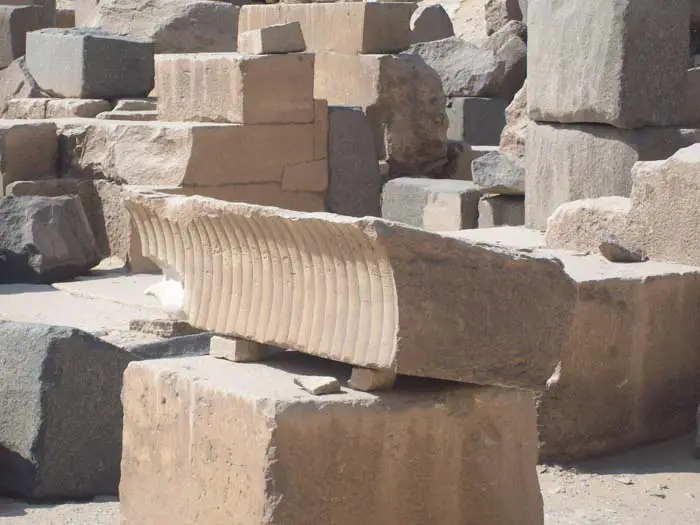
© isawnyu - Stone blocks from the mortuary temple of Sahure
Wall reliefs covered most of the temple walls and included images and inscriptions. The Hypostyle hall often contained scenes and inscriptions of a historical nature. These reliefs detailed events from a pharaoh’s reign or important temple events. Other carved reliefs showed rituals conducted in specific rooms. Many of these showed the pharaoh conducting the ritual. The reliefs also had images of the gods and some of the myths about the gods.
Temple Features
Inside ancient Egyptian temples, there was a segregated system of sanctuaries, divided by the spiritual level of the people allowed to enter them. Those who had not yet reached spiritual worthiness were not allowed to enter the innermost chambers. Some Egyptian temples also had an exterior complex comprised of gardens and courtyards.
Obelisk - carved monuments that pharaohs put up near pylon entrances.
Pylon - giant gateway that provided entrance to a temple with carved images of the pharaoh.
Inner Sanctuary - the place where priests placed the god’s statue. It contained a box where priests kept the statue at night. An altar was near the box and priests put the statue on the altar every day and presented it with offerings.
Barque Chamber - the storeroom for the miniature boat that carried the god’s statue.
Storerooms - the places for goods used in rituals.
Courtyard - the area where people placed statues and votive offerings dedicated to the god.
Statues - images of the gods or pharaohs.
Votive Offerings - amulets, steles or statues dedicated by people to the gods. These could include a prayer for help or thanksgiving. Sometimes priests removed these items from the courtyard and buried them. One of these caches at the temple of Karnak contained over 17,000 items.
Hypostyle Hall - covered hall filled with carved columns. Most of the columns had carved tops that resembled plants.
Sacred Pool - a pool of water where priests bathed to ensure their ritual purity.
Processional Way - used during festivals when priests carried the god’s statue in a barque. They were often lined with sphinx statues which the Egyptians considered guardians.
Barque Shrines - way points along the processional way where the barque stopped.
Workshops - places where people manufactured ritual objects and temple furniture.
Enclosure Wall - wall built around the temple precinct to separate it from the city and limit access to the precinct.
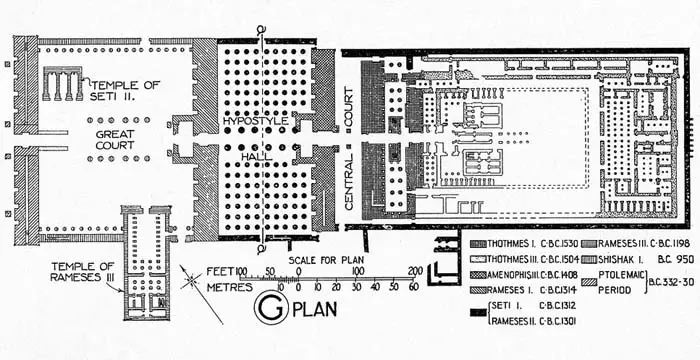
© psulibscollections - Temple of Amon -- Plan
Household Shrines
Household shrines where places in a private home that had offering tables. Individuals worshiped state gods like Amun-Ra in their homes. Two of the gods worshiped in homes were Bes and Tauret. Bes was the protector of young children and he assisted with childbirth. Tauret was the goddess of childbirth and fertility. People left votive offerings at their household shrine. These included steles carved with requests for help or thanksgiving.
Temple Employees
Priests
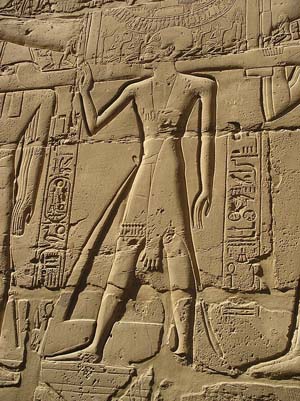
© Kenzyb - Karnak temple, priest relief
There were two types of priests in Ancient Egypt; full-time and lay priests. Full-time priests served the gods at all times. Lay priests served for three months a year, serving one month and then taking three months off before serving again. During the off times, lay priests had other jobs such as doctors or scribes. The High Priest oversaw all activities of the temple. Waab priests performed rituals and had to maintain ritual purity.
Priests attained their positions in several ways. The first way was for a man to inherit his position from his father. Another way was through an appointment by the pharaoh. A man could also buy a position in the priesthood. Priests voted to appoint a priest to a higher position.
A priest had to do several things after attaining his position. First a priest was circumcised, if he was not already. A serving priest had to be celibate and lived in the temple precinct. Priests were not permitted to wear any items made of animal products. Their clothes were made of linen and their shoes were also made of plant fibers.
Overtime, the priesthood of Amun achieved great political power. After the New Kingdom period, the High Priest of Amun had the power to give or withhold the god’s favor on the crown prince. Women held the position of God’s Wife of Amun and also had political power. They had to remain celibate at all times and adopted their heirs from the royal family. These women conducted some of the religious rituals.
Other Employees
Craftsmen - made the votive offerings, statues, jewelry, clothing and ritual objects for the temple.
Cleaners - kept the temple and its grounds tidy.
Farmers - raised the food used in temple rituals.
Slaves - usually foreign prisoners-of-war who worked in the temples.
Rituals
Through most of the ancient Egyptian history, there was a polytheistic religion where individuals were free to worship any god or goddess they chose. In most cases, multiple deities were worshiped. Some gods and goddesses enjoyed fame throughout Egypt, while others were limited to worship in select cities and villages. Each town had a patron god and a temple dedicated to that deity. An order of high priests oversaw the temple, the rites and the daily activities associated with the temples.
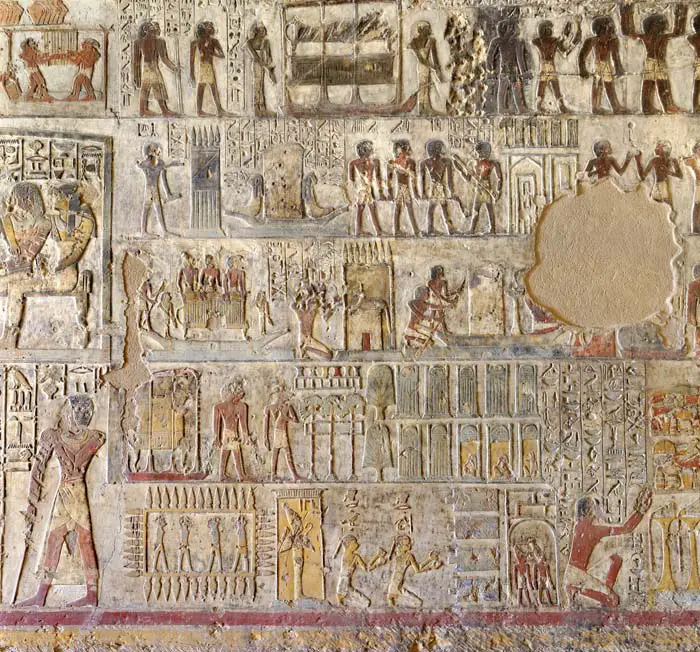
© kairoinfo4u - Depictions of rituals at the Tomb of Paheri
Rituals conducted at ancient Egyptian Temples served several purposes. First, they provided the gods with basic items like food and clothing. Rituals also ensured the god’s help in battle and the land’s fertility. Egyptian rituals hinged on the idea that providing goods for the gods ensured their protection and help. Festivals were rituals that took all the people could celebrate. During some of Amun’s festivals, people could ask the god questions. The priests would move the barque to show the god’s answer.
Daily Rituals
The priests and, sometimes, the pharaoh performed certain rituals daily. Pharaoh made offerings at some of the major temples. Priests who performed the daily rituals had to bathe in a sacred pool several times a day. The priest entered the Inner Sanctuary in the morning and removed the statue from its box.
Then, he washed the statue and dressed it in new clothing. The priest put fresh makeup on the statue and set it on the altar. He presented three meals a day to the statue while it set on the altar. After the statue ate, the priest took the food and distributed it to the priests.
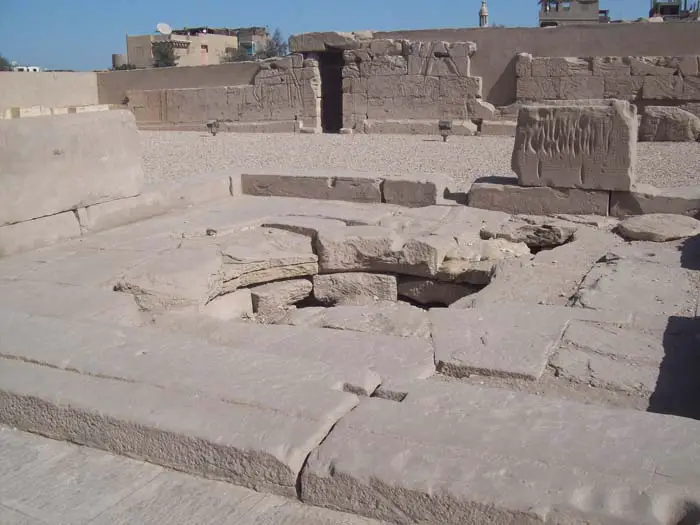
© isawnyu - Abydos -- Absolution well - used for the purification of priests
Festivals
Dozens of festivals took place throughout Egypt every year. These were times when the people could see the god’s statue as the priests carried its barque. One festival, the Beautiful Feast of the Valley, took place in the city of Thebes. During this festival, the Statue of Amun traveled from the Temple of Karnak to the western bank of the Nile. On the western bank, Amun visited the mortuary temples of previous pharaohs. Festivals helped ensure the Nile’s flooding and promoted the land’s fertility.
Temple Building Rituals
Priests conducted some rituals at different stages of a temple’s construction. The first ritual took place when the priests marked off the sacred space for the temple enclosure. The next ritual happened when the priests measured the dimensions of the temple building. Priests placed foundation deposits under the stones of the temple's foundations. After the temple's completion, the priests consecrated and named the building.