
 Ancient Egypt Home
Pharaohs
Egyptian Gods
Egyptian Pyramids
Hieroglyphics
Temples
Life in Ancient Egypt
Maps of Ancient Egypt
History of Egypt
The Queens of Egypt
Mummies
Religion
Cities and Regions
Ancient Egypt Facts
Ancient Egypt For Kids
Ancient Egypt Home
Pharaohs
Egyptian Gods
Egyptian Pyramids
Hieroglyphics
Temples
Life in Ancient Egypt
Maps of Ancient Egypt
History of Egypt
The Queens of Egypt
Mummies
Religion
Cities and Regions
Ancient Egypt Facts
Ancient Egypt For Kids
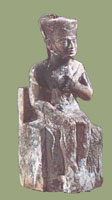
Khufu (aka Cheops)
Period:
Old Kingdom / 4th Dynasty
Death:
2566 BC
Reign:
2589 BC – 2566 BC
Father:
Snefru
Mother:
Queen Hetepheres I
Spouse:
Meritites I
Offspring:
Kawab
Djedefhor
Hetepheres II
Meritites II
Meresankh II
...
Monuments:
Great Pyramid of Giza
Khufu ship
King Khufu and the Great Pyramid
Khufu (aka Cheops) ruled during the Old Kingdom and was the second pharaoh of the fourth dynasty of kings. He succeeded his father, Pharaoh Snefru, and ruled from 2589 BC to 2566 BC, although this is a general estimation as far too little is known about this famous pharaoh.
What’s in a Name?
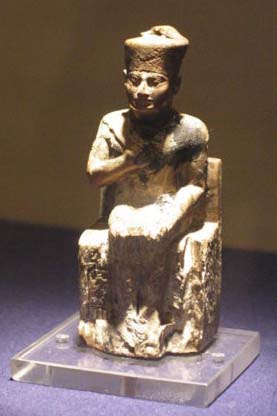
© JMCC1 - Statue of Khufu
Known by many names, Khufu, whose full name was Khnum-Khufwy, means “Khnum Protects Me.” Khnum was the ancient Egyptian ram-headed god of procreation, water and fertility. The Greeks gave Khufu the name “Cheops” and he is probably best known throughout history by this name.
King Khufu is also known under his hellenized name Cheops (or Khêops).
The King and His Family
Khufu’s father, Snefru, first king of the 4th dynasty, was granted kingship through marriage, instead of like most kings who were declared kingship through birthright. Khufu’s mother was Queen Hetepheres, who was likely Snefru’s half sister. Khufu married Queen Meritites and Queen Henutsen. It was Queen Merities (his principal wife) who gave birth to Khufu’s heir to the throne, Prince Kawab. However, Prince Kawab died before Khufu and was never able to assume his kingship. It has been suspected that he was the victim of foul play, perhaps murdered by Djedefre, one of his brothers. Khufu had nine sons and fifteen daughters, and every one of them was somehow placed in the royal court with impressive positions.
A Famous Pharaoh and an Infamous King
Thousands of years after his reign, Khufu is widely believed to have been a cruel king to the Egyptian people. However, there is not a lot of evidence to support this. Rumors have existed for millennia that the king forced people as slaves to build his pyramid (The Great Pyramid of Giza) but there is evidence to suggest that the laborers not only called themselves “friends of Khufu” but they were also paid for their work. It is widely believed, however, that Khufu exchanged the life of a criminal to allow a magician to test his skills of resurrection. It is because of these rumors that Khufu is not just a famous pharaoh, but an infamous one, as well.
The Great Pyramid at Giza
Also known as the Great Pyramid of Khufu, the great pyramid is Khufu’s best known legacy. It remains today as one of the seven wonders of the world. At the time and through the millennia, the remarkably advanced technology and insight lent to Egypt’s reputation as being a highly sophisticated civilization to the rest of the world.
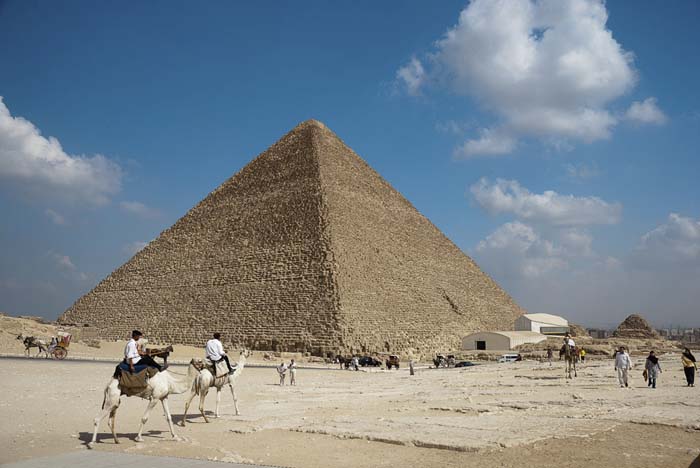
© schmaeche - The Great Pyramid of Cheops at Giza
The Great Pyramid at Giza took approximately 20 years to build. It stood 480 feet tall, 31 of which have eroded since the time of the pharaoh. It remained the tallest man-made structure in the entire world for nearly 4,000 years. The pyramid’s architect, Hemiunu, doubled as Khufu’s vizier, which made Hemiunu the second most powerful man in Egypt at the time. Khufu believed the Great Pyramid was his stairway to heaven. The Great Pyramid was the first of its kind in that the sides were smooth, as opposed to having steps. Also, the sides perfectly correspond with the cardinal points of a compass. The north side faces the north, the east side faces the east, etc. It has been estimated that at least 2.3 million limestone stones were used in the construction of the Great Pyramid of Khufu. Each of these 2.3 million limestones weighs between two and 15 tons.
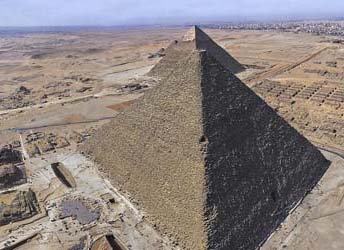
© kairoinfo4u - Giza complex from the air
There are two entrance ways into the Great Pyramid. The original entrance is 55 feet above the ground and off center. The second was created by Arab soldiers who spent three months carving their way through the rock. This is known as the forced entrance.
Learn more about the Great Pyramid of Giza...
The Interior of the Great Pyramid of Khufu
The interior of the great pyramid of Khufu contains:
- A descending passageway off of the forced entrance leads to the lowest chamber, also known as the subterranean chamber. This chamber is 79 feet below ground. Some Egyptologists believe Khufu originally intended to be buried here, but later changed his mind.
- The descending passageway connects to an ascending passageway. The ascending passageway opens into the Grand Gallery.
- The middle chamber, or Queen’s Chamber, can be accessed through the Grand Gallery. However, no queens were ever buried here.
- The Grand Gallery stands 161 feet long and 49 feet high.
- Passageways were only three feet wide and four feet high.
- The King’s Chamber is located at the top of the Grand Gallery. The King’s Chamber is a large rectangular room. The only thing found inside the King’s Chamber was an empty red granite sarcophagus.
- The sarcophagus sits at the very center of the pyramid.
- Weight-relieving chambers were placed above the King’s Chamber to distribute the weight of the pyramid and keep it from collapsing into the King’s Chamber.
- Air shafts exist in both the Queen’s Chamber and the King’s Chamber. The air shafts are directly lined up with the angle of the pyramid. The only difference is the King’s Chamber air shaft reaches the outside as a small rectangular opening. The Queen’s Chamber air shaft does not reach the outside, but is blocked by stone.
- The King’s Chamber air shaft was likely created to help Khufu’s soul reach the afterlife.
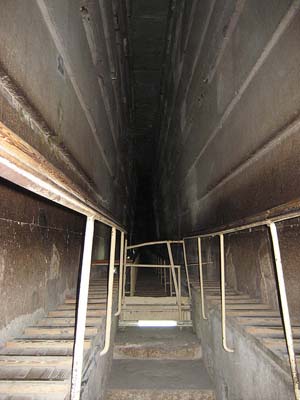
© a rancid amoeba - The Grand Gallery
This illustration shows you how Khufu's Great Pyramid looks on the inside:
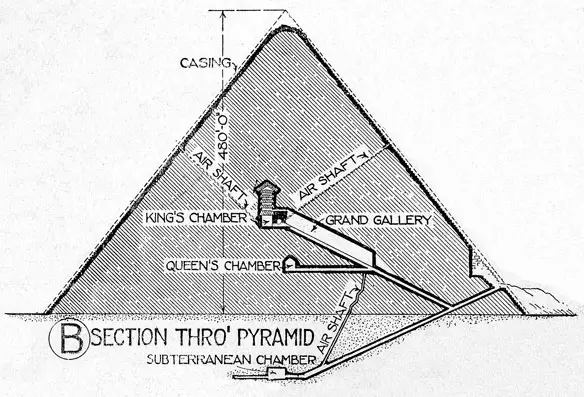
© Penn State University Library - The inside of the Great Pyramid of Khufu
Abydos Boats
Dating back in time 5,000 years ago, the Abydos Boats were created. 14 vessels have been discovered at 60 to 80 feet in length. They were found in Abydos, Egypt, nearly eight miles from the Nile River. These boats are significant because they reveal ancient Egypt’s truly advanced technology. These boats were intended to help the deceased king reach the afterlife. The Abydos Boats were actual boats that could hold up to 30 rowers and were likely painted yellow. The Abydos Boats served as the prototype for later actual and symbolic funerary boats for future kings.
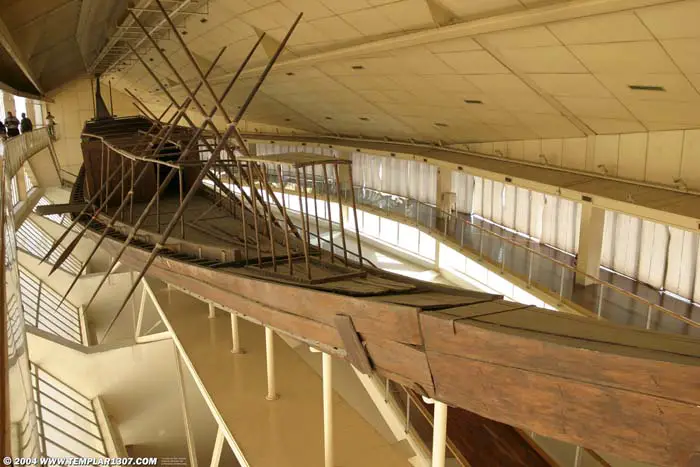
© Benjamin - Khufu's Barge at Giza
Khufu created the most elaborate of the funerary boats. His ship, made of tamarix (salt cedar), is credited with being the most famous of these boats. This ship was fully intact at the time it was discovered. It had been sealed into a pit at the Great Pyramid at Giza around 2,500 BC. This ship was intended to carry Khufu to the Sun God, Ra, while together they sailed the heavenly Nile.
Quick Facts about Khufu
- He is known best for his contribution to architecture through the construction of the Great Pyramid at Giza.
- Although it seems as though the Great Pyramid was built as a mortuary temple, Khufu’s sarcophagus was found, but his mummified remains never have been.
- Due to the enormity of the Great Pyramid, speculation exists today as to how it was built.
- An ancient Egyptian cult worshiped Khufu as a God some 2,000 years after his reign.
- Khufu, disdainful toward the gods, ordered the Egyptian temples shut down, but later apologized and had them reopened.
- Khufu’s ship measures 143 feet long and nearly 20 feet wide, and could sail today if placed in a body of water.
- The only Khufu statue in existence is a three inch high ivory statue discovered at Abydos.