
 Ancient Egypt Home
Pharaohs
Egyptian Gods
Egyptian Pyramids
Hieroglyphics
Temples
Life in Ancient Egypt
Maps of Ancient Egypt
History of Egypt
The Queens of Egypt
Mummies
Religion
Cities and Regions
Ancient Egypt Facts
Ancient Egypt For Kids
Ancient Egypt Home
Pharaohs
Egyptian Gods
Egyptian Pyramids
Hieroglyphics
Temples
Life in Ancient Egypt
Maps of Ancient Egypt
History of Egypt
The Queens of Egypt
Mummies
Religion
Cities and Regions
Ancient Egypt Facts
Ancient Egypt For Kids
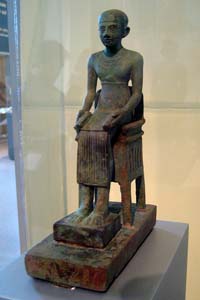
Imhotep
Period:
Old Kingdom / 3rd Dynasty
Lifespan:
c. 2650–2600 BC
Father:
Kanofer (Uncertain)
Mother:
Khreduonkh (Uncertain)
Monuments:
The Step Pyramid
Cult Center:
Memphis
Imhotep
One of the Ancient Egyptians most revered in his time and after, was not a king, but a man by the name of Imhotep. His name means "the one who comes in peace", and it is a befitting name for someone held in such esteem even after his death.
Who was Imhotep?
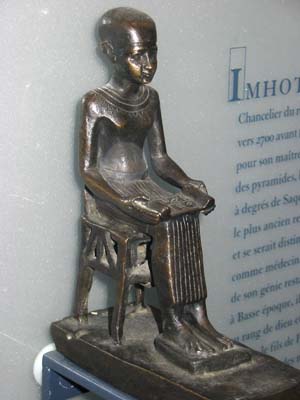
© Hu Totya - Statuette of Imhotep
Imhotep was a revered healer, architect, High Priest, sage, and adviser to King Djoser. Born a commoner, Imhotep became preeminent in his time in many fields. What we know of his life is fascinating.
Scholars think he was born in either Ankhtow, a suburb of Memphis, or Gebelein, a village south of Thebes in the 27th century BC. He was born on the 16th day of Epiphi, the third month of harvest. His father may have been another architect, Kanofer. His mother may have been Khreduonkh, from the province of Mendes.
It is believed Imhotep served under as many as four kings. His burial place was not known after his death. Although likely to be somewhere in Saqqara, it is a prize yet to be found.
Archaeological Evidence
Historians thought Imhotep to be a mythological figure until the late 19th century. C.E. Wilbour discovered the Famine Stela in 1890, carved in granite at the upper cataract of the Nile River near Aswan.
The Stela records a seven year famine during the time of King Djoser, also known as Zoser, and names Imhotep as Chief Priest and architect to the King. It tells how he aided the King in ending the famine. It also credits him as the architect of the first known pyramid along with its surrounding complex.
Archaeologists discovered more evidence of his existence on a pedestal of a statue of King Djoser, now known as Cairo JE 49889. The carving names Imhotep as “Chancellor of the King of Lower Egypt, the first one under the King, the Administrator of the Great Mansion, the hereditary noble, the High Priest of Heliopolis, the chief sculptor and the chief carpenter.”
Architecture
As an architect, Imhotep's skills are legendary. The Step Pyramid is the oldest of the Seven Wonders of the Ancient World. It was the first pyramid built, as well as the first structure of any kind of cut stone. Finished in only 20 years, it stands almost 200 feet tall. Built of 6 huge steps, they are a giant staircase for the King to climb after his death on the way to the sun god, Ra.
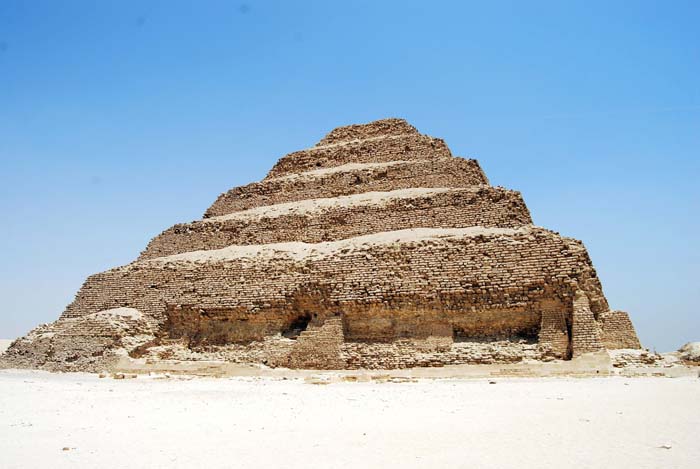
© John Solaro - The Step Pyramid at Saqqara
Scholars think he began the unfinished pyramid of Sekhemkhet and also the Edfu Temple. Imhotep was the first to use columns to support a building, and Manetho credits him as being the pioneer of stone dressing a building. He authored an encyclopedic text used by Egyptian architects for thousands of years after his death.
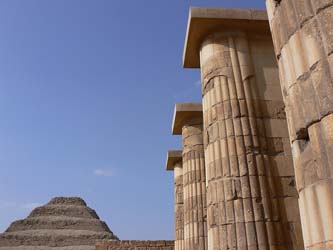
© Lars Plougmann - Columns near the Step Pyramid
Medicine
As a physician, he was unique in his time. Imhotep’s writings are the first to reject magic for dealing with illness, based on the premise that illness was caused by the environment, rather than the gods.
Imhotep is believed to be the original author of the content of the Edwin Smith Papyrus, the earliest known writing on medicine.
The Papyrus includes information on trauma surgery, anatomy, and contains the first known descriptions of cranial sutures, the external surface of the brain, and cerebral spinal fluid. It also contains the diagnosis, treatment, and prognosis of 48 medical issues. It is the earliest writing explaining trepanation, a means of relieving pressure on the brain.
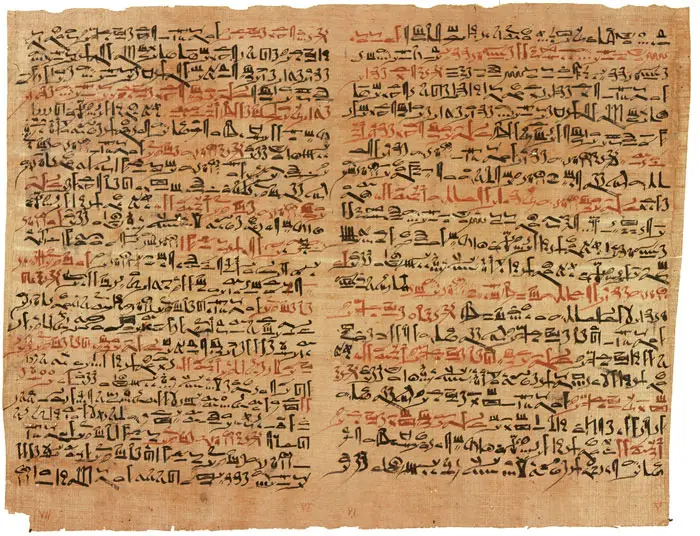
© Jeff Dahl - Fragment from the Edwin-Smith Papyrus
Imhotep is the first known physician to have extracted medicines from plants. He is credited with the diagnosis and treatment of over 200 medical issues. Sir William Osler, the father of modern medicine, called him “the first figure of a physician to stand out clearly from the mists of antiquity.”
Imhotep as a Deity
The deification of Imhotep began shortly after his death, with the status of medical demi-god only one century later. The Persians conquered Egypt in 525 BC. People began worshiping him as a god then, one of only two mortals ever given this distinction.
His temple was in Memphis, where he replaced Nefertem in the Great Triad of Ptah, Sekhmet, and Imhotep. The Turin Canon lists him as “Son of Ptah”, the creator god. Taimhotep, who lived during the reign of Ptolemy XII recorded on her Stela that she prayed to Imhotep Son of Ptah and birthed a son.
Facts about Imhotep
- Imhotep was a revered healer, architect, High Priest at Heliopolis, sage, and adviser to King Djoser - his 2nd in command.
- He was thought to be a mythological figure until the late 19th century. Proof of his existence was first found by C.E Wilbour in 1890.
- Born a commoner in the 27th century BC, he worked his way up by his genius.
- Imhotep was the first Master Architect known by name. He authored an architectural encyclopedia used by his peers for millennia.
- He was the architect of the oldest known pyramid, the Step Pyramid in Saqqara.
- First known to have used columns to support a building.
- First Physician known to reject magic and look to science to heal.
- First to extract medicine from plants.
- One of two mortals to be raised to the status of god in Egypt, in 525BC, Imhotep was worshiped at his temple in Memphis.
