
 Ancient Egypt Home
Pharaohs
Egyptian Gods
Egyptian Pyramids
Hieroglyphics
Temples
Life in Ancient Egypt
Maps of Ancient Egypt
History of Egypt
The Queens of Egypt
Mummies
Religion
Cities and Regions
Ancient Egypt Facts
Ancient Egypt For Kids
Ancient Egypt Home
Pharaohs
Egyptian Gods
Egyptian Pyramids
Hieroglyphics
Temples
Life in Ancient Egypt
Maps of Ancient Egypt
History of Egypt
The Queens of Egypt
Mummies
Religion
Cities and Regions
Ancient Egypt Facts
Ancient Egypt For KidsThe Great Sphinx of Giza
With dimensions of 66 feet (20m) high, 241 feet (73m) long, and 63 feet (19m) wide, the Great Sphinx of Giza is the largest structure created from a single piece of stone. It is also a figure synonymous with ancient Egyptian culture and remains shrouded in mystery.
Looming over the West bank of the Nile River in Egypt, the Great Sphinx of Giza is a massive limestone statue in the likeness of a mythical creature called a sphinx. Often simply referred to as "the Sphinx" in English; in Arabic its name literally translates as "Father of Dread."
The statue sits in a reclining position, with the lion's body and paws facing forward. The creature's human head is generally thought to be the likeness of Pharaoh Khafre.
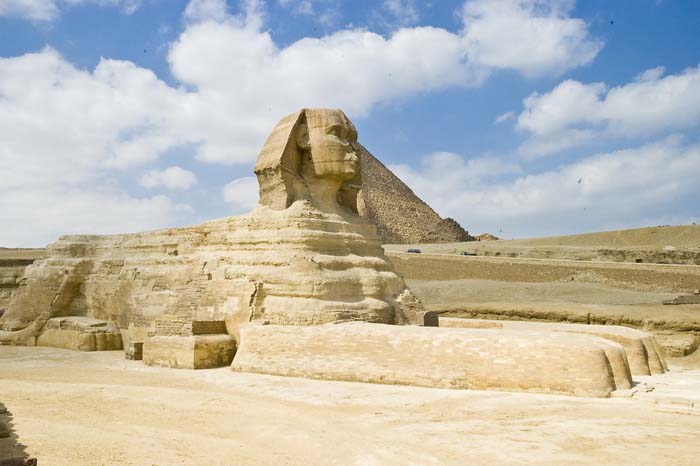
© Jack Versloot - The Great Sphinx at Giza
The Giza Plateau
Located on the Giza Plateau, the Great Sphinx of Giza is one of several monuments in the area, which includes the Giza Necropolis. The Giza Plateau is a sandy plateau in Giza, Egypt that overlooks the West bank of the Nile River.
Modern Giza receives access from two primary roads. From the north, the first road leads to the pyramids of pharaoh Khufu, while the second comes from the east and leads to the Great Sphinx's forecourt. The roads cross the Nile from the east and continue West.
The three pyramids of pharaohs Khufu, Khafre and Menkaure dominate the plateau, with the largest one belonging to Khufu. The location of the Great Sphinx is slightly South and East of Khufu's Great Pyramid.
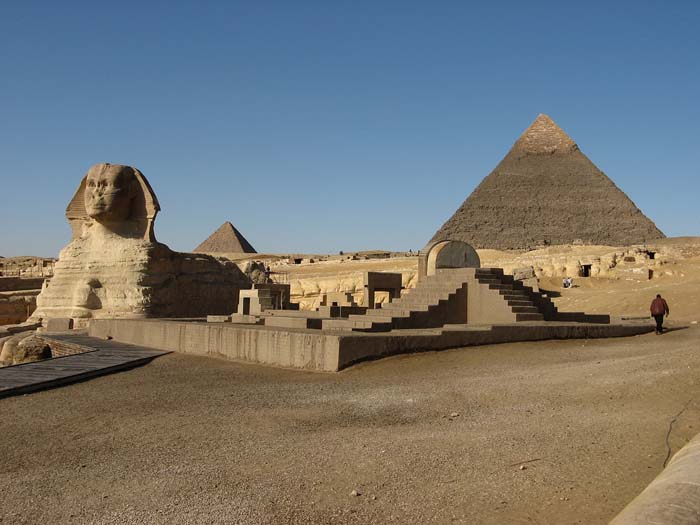
© raunov - The Sphinx on the Giza Plateau
When was the Great Sphinx Built?
Modern Egyptology largely agrees that the Sphinx was built around 2500 BC during the reign of Pharaoh Khafre, whose face it is thought to bear a likeness. However, dissenting opinions to this commonly accepted time frame exist.
In fact, Egyptologist Selim Hassan admitted that the evidence for the theory of the Sphinx being built for Khafre during his reign was circumstantial at best. After all, no inscriptions on the statue exist tying its construction with anyone.
Early Egyptologists believed that the Sphinx stele (stone slab with hieroglyphs) shows that the monument became buried in the desert before the time of Khafre. More modern theories say that the Sphinx appears constructed more in the style of Pharaoh Khufu, who was Khafre's father.
Khafre's Causeway, in particular, appears to have been built with an existing structure in mind and that could have only been the Sphinx. Another more fringe theory is that the water erosion on the Sphinx suggests construction during a time when heavy rain was common in Egypt, thus putting its construction somewhere between 4000 and 3000 BC.
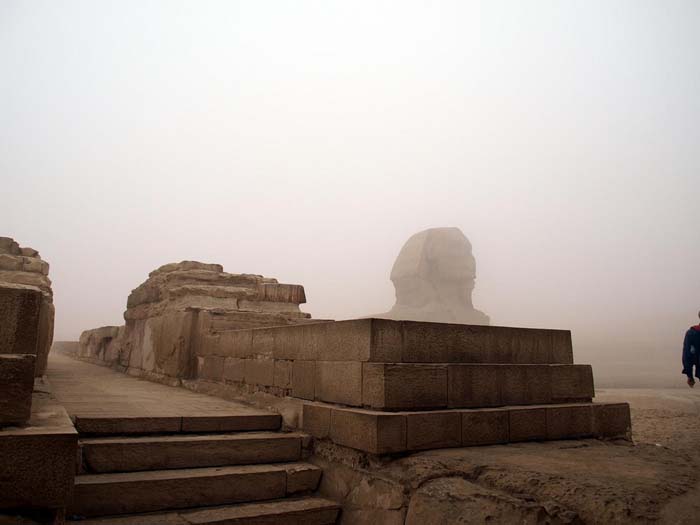
© Derek Meyer - The Sphinx and Khafre's Causeway
Why was the Great Sphinx Built?
If the Sphinx was truly built during the reign of Khafre, then it is likely that it was built for that pharaoh. Keeping in mind that the Sphinx is only one of several structures erected as part of the deceased king and sun god cult, the monument may have had the purpose of connecting the dead pharaoh with the sun god. The translation of the Egyptian term for sphinx is "living image of Atum." Atum was both the god of creation and the setting sun.
A Lion's Body
Perhaps the most notable aspect of the Great Sphinx's appearance is that it possesses a lion's body and a human face and head. This appearance is only one of many forms the sphinx has taken. It is the human head of the Sphinx that tends to be the subject of debate. The question is whether the head was meant to be a man or a woman and whether the face was typically African.
Some early drawings make the Sphinx look very definitely female, while others make it look very definitely male. Complicating the issue is the fact that at some point, something or someone removed the nose, as well as the lips. The flat profile of the face makes it difficult to tell how the Sphinx originally appeared.
A fringe theory offered by surgeon Hutan Ashrafian says that the human inspiration behind the statue may have been a person with prognathism (refers to a protruding jaw), which is a condition creating lion-like features and a flat profile.
Two authors, Graham Hancock and Robert Bauval, connect the sphinx to astrology. They claim that the lion shape is a reference to the constellation of Leo, the pyramids at Giza a reference to Orion and the Nile a reference to the Milky Way. In general these claims are regarded as pseudo science and have been refuted.
© Norman Walsh - The Great Sphinx
Construction of the Great Sphinx
The Great Sphinx of Giza was constructed out of one large limestone ridge, measuring 241 feet long and 66 feet tall. This stratum varies in color from soft yellow to hard gray. The body of the Sphinx was constructed out of the softer, yellow stone, while the head was made from the harder gray stone. Other than the missing nose and lips of the Sphinx, the head remains the most defining characteristic while the body has suffered from erosion.
The Sphinx's lower body was constructed of huge stone blocks from the base quarry. Engineers used the blocks for the nearby temple masonry as well. Construction began on the Sphinx through excavation around the rock outcrop and removal of the resulting huge blocks. The monument was then carved out of the exposed rock. Because of this method of construction, modern carbon dating has proven useless in identifying the Sphinx's exact date of construction.
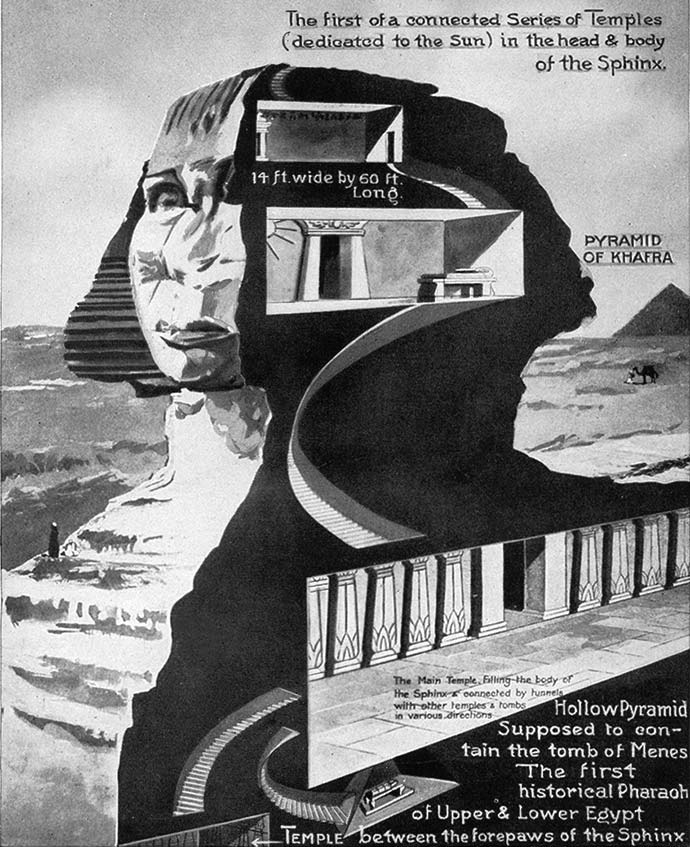
There were three tunnels built in the Sphinx, but the passage of time has left the destinations unreachable and the tunnels themselves seem to basically stop short. Because of the limited resources and writing found on and around the sphinx, very little else is known about the structure (hence the "Riddle of the Sphinx"). All that we can be sure of is its immensity and the level of craftsmanship required to build it.
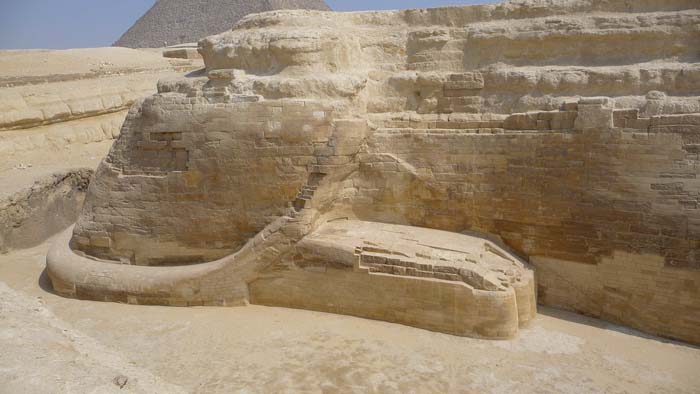
© Cary Bass-Deschenes - Detail of the Great Sphinx
Mythology of the Sphinx
In mythology, the Sphinx is a monster with at least a lion's body and human head. In some traditions, the Sphinx also has wings like a great bird. The Greek Sphinx had a woman's head, while in Egyptian mythology, it had a man's head. The Sphinx was a cruel and ravenous monster in Greek mythology, often asking riddles and eating those who could not give the correct answer.
In contrast, the Egyptian Sphinx was largely viewed as benevolent and as a guardian.
The Greek Sphinx was also often depicted as a guardian, but a merciless one. Probably the most well-known Sphinx outside of the Egyptian statue, the Greek Sphinx was actually a single sphinx guarding the entrance of the city of Thebes. Considered a demon of doom and destruction, the Greek Sphinx had the head of a woman, the body of a lion, wings of an eagle and a serpent for a tail.
Discovery and Restoration
Restoration of the Great Sphinx was first commissioned in about 1400 BC by Thutmose IV. He ordered a team to dig out the buried front paws and then placed a slab of granite later called the Dream Stele. It is thought that Ramesses II may have ordered a second excavation during his time between 1279 and 1213 BC.
The first modern attempt at digging out the Sphinx came in 1817 AD. This dig completely uncovered the chest of the Sphinx. Between 1925 and 1936, the entire Sphinx was finally dug out. Engineers restored the Sphinx's head in 1931 upon orders from the Egyptian government.
Restoration of the Sphinx continues today, though some of the restoration masonry employed has done more harm than good. Deterioration of the layers on the Sphinx continues, especially on the chest area.
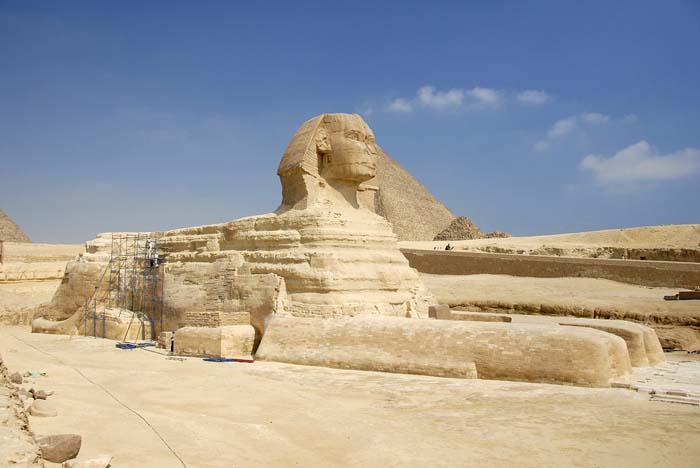
© superblinkymac - Restoration Works at the Great Sphinx
Quick Facts About the Great Sphinx of Giza
- The Great Sphinx is a massive stone carving of a mythological creature with the head of a man and body of a lion.
- The sculpture sits on the west bank of the Nile in a shallow depression as part of the Giza Necropolis area.
- The Sphinx bears no inscriptions as to who built it or when or why.
- The Sphinx is commonly thought to have been built around 2500 BC, but may be much older.
- Various attempts at restoration have been made, but the Sphinx continues to deteriorate naturally.